First listen
to learn their language.
Then question
to understand their lives.
Next seek
to know, what they know.
Then frame how best to express solutions.
The Master Seller
Walks in their shoes,
Listening without judging
Building credibility and trust
Marketing the buyer with relevance
Spoken in the Words of the audience.
As the world changes, you will be faced with a series of challenges. As a marketer trying to decide what niches to approach, or as a sales person coaching a prospect through a purchase, the ability to make a decision is a critical skill for success. For some, decision-making is a case of following their gut. For others, decision-making is a glacial experience, fraught with indecision. Ben Franklin once said “By failing to prepare, you are preparing to fail.” To ensure preparation and aid his decision-making, Franklin had a simple tool that is both prudent and timely.
To use the “Ben Franklin” system, take a lined pad and write the question to be decided at the top of the page and below divide the remaining sheet into two vertical columns. The left is for the negative consequences of your action and the right is for the positive benefits. Consider the question at hand and start to fill in the columns, with a consequence or benefit in each row. When done, the side with the most reasons wins.
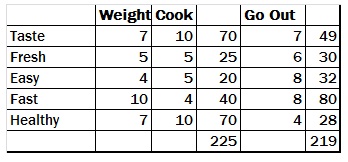
A variance of this process is to “weight” each element that influences the answer. Again, each column(s) is a candidate answer to your question. Add another column to “weight” each element. Each element should have a value in all columns that represents its value for each answer. Multiply the weight of the element to value for each column and place the answer in another column. When complete sum the rows and the number with the largest total wins.
Should I stay home or go out to eat tonight?
Example of a Ben Franklin Matrix
You may take the advice of the matrix, you may not. But in going through the process you will become awake to the reality of the situation. It is always best to be informed with eyes wide opened.
Are you trying to be all things to all people? Do you tell yourself that the “whole world” could be your customer? Don’t fool yourself! A Swiss Army knife may have a can opener, corkscrew, scissors, screwdriver, nail file, bottle opener and lastly a knife all built into one multi-tool. But when push comes to shove it’s not a very good can opener, corkscrew, scissors, screwdriver …….etc. Most people have a drawer filled with utensils designed to be only bottle openers or knives. And they prefer these single use tools because they provide a superior service for the task at hand. Most likely you’re not selling Swiss Army knives but instead fine carbon steel cutlery for chefs. Do you know that?
Bu out in the woods, huddled over a fire, the Swiss Army knife, compactly stored in your coat pocket is EXACTLY the right solution. This niche market, the market of campers shivering outdoors, is the target market. What is your niche? Who are the people you uniquely serve?
Awake to the marketplace
Never underestimate the competition
Respecting their strengths
Yet keen to their weaknesses
Discovering opportunities
Ever watchful of impending threats.
Underestimating your competition
means thinking that they are evil
You destroy the three greatest things
of Patience, Simplicity, Collaboration
and become an enemy to yourself.
Awareness is the fundamental task of marketing; to take a solution or product that you’ve polished and honed and generate a conversation about something that hasn’t existed before. By awaking the market place, the task is to have buyers consider “This might work for me!”
When there is no conversation, there is no awareness. In the dark, your solution will fall like so many before it, into the rubbish heap of “good ideas”. Persistence and tenacity are the keys to success.
Consider following:
1. What is your competition, their pros and cons?
2. Distinguish the niche market, your solution can help.
3. Define your marketing tactics, delineate market channels your niche reside.
4. Create a marketing message that speaks emotionally to your audience.
5. Trial your message in one campaign and test if it speaks to the buyer.
6. Polish and tune the message as you roll out, channel by channel.
7. Measure ROI on each campaign.
Have you taken the time to awake the market place? Are you clear on how you position your products? Does the message you share speak to the needs of buyer?
At first a secret
a new product’s value is questioned
The market unaware
Remains wary and skeptical.
Like rushing water
Wearing away granite
Persistent ads bring awareness
Messaging that speaks to the buyer
That this can help
This can make a difference.
Knowing the audience
The Master Seller makes the unknown known.




 The Tao Te Ching of Sales